Research Goals
Conduct family history research in Germany for a family who likely resided in or around “Hanover, Germany” in the first half of the 19th century.
Known Information
Based on information outlined in the family’s history sketch, the family emigrated from the Port of Bremen in 1851. Information identified in the Ship’s Manifest confirms that the family emigrated from the Port of Bremen to the United States and arrived in the port of New Orleans in 1851.1 While reviewing information in the German Emigrant Databank from the Historical Museum of Bremerhaven, documents associated with the family’s 1851 emigration were discovered, correlating with the Ship’s Manifest.2
Research Questions
- Where did the family reside prior to emigrating to the United States in 1851? On-hand documentation indicated “Hanover” — but did that mean the city, or the region?
- What were the birth names of the emigrating couple?
Identifying the exact location of residence was key to discovering proof documents that would confirm the identity of the individuals listed on the Manifest.
Note
After researching online repositories such as Ancestry and FamilySearch for family members who arrived in New Orleans in 1851, an obituary was discovered for the oldest child of the couple in a local newspaper. The birth information found in the obituary correlated with other documentation, and provided the first evidence of a more precise place of birth than simply “Hanover” — a specific parish in Lengerich, Emsland.
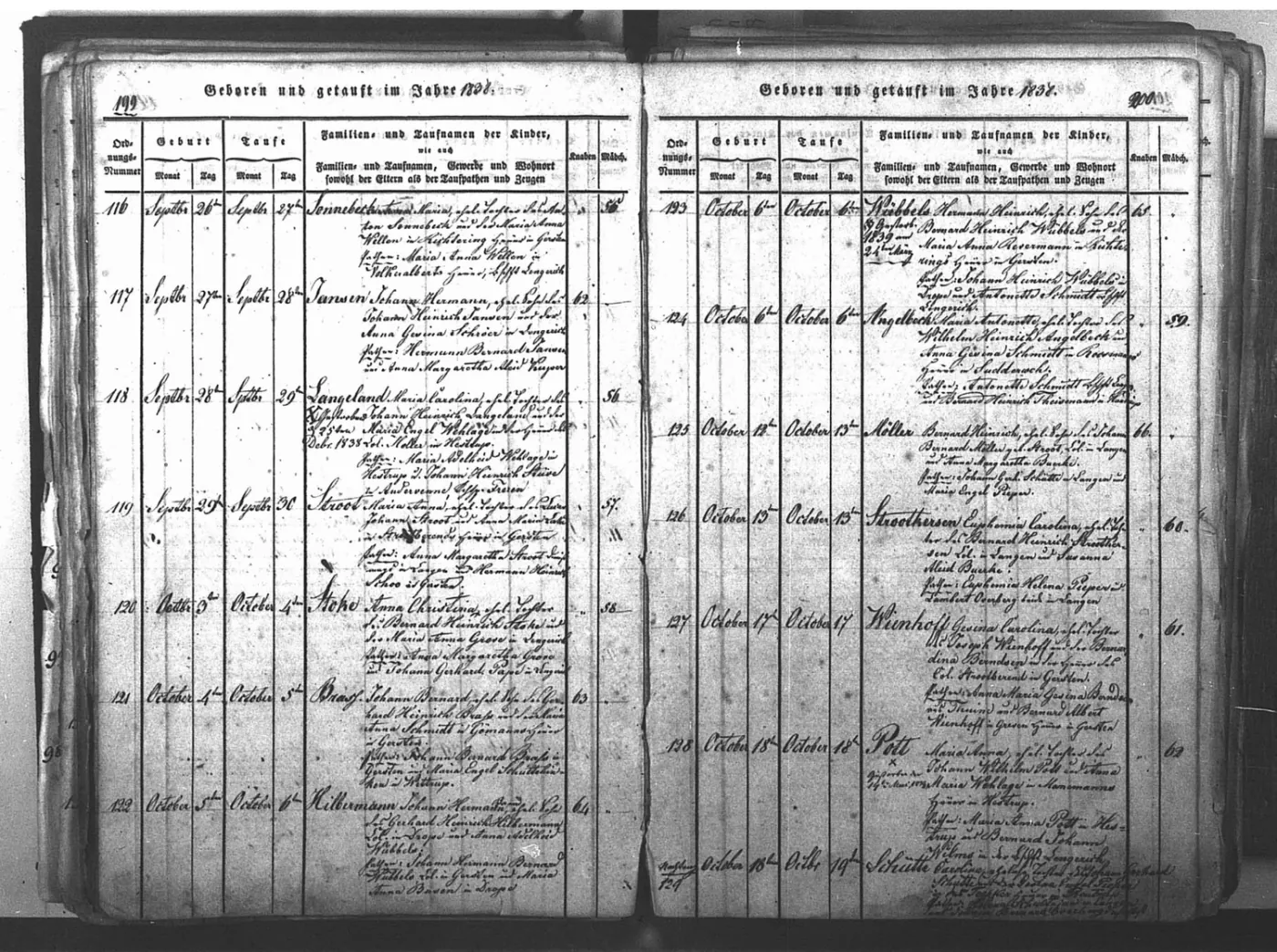
Assuming the family was Catholic, research on Matricula.de identified the one parish in the area with records dating back to the early 19th century — leading to a baptismal record for a member of the family, shown below.
Executive Summary — Challenges and Limitations
One of the main challenges faced in this research project was the fact that although family members indicated they were from “Hanover, Germany,” Germany as a nation did not exist in 1851. German unification did not take place until 1871. Prior to that, “Germany” consisted of 25-plus principalities, one of them being the Kingdom of Hannover.
Therefore, initial research focused on utilizing US online repositories with an intent to discover pieces of information that would lead to identifying a town or community of birth or residence. Since the family both anglicized and adjusted the order of their given names over time, initial research revolved around using various spellings and alternate name orders to find documents providing more detail about the family’s life in “Hanover” prior to emigration.
Key Facts That Impacted This Research
- Following the Congress of Vienna in 1815, the Kingdom of Hannover was created and remained so until 1866.
- While under French control, registration of citizens took place in the Hannover area from 1811–1815. Official population records did not begin in Germany until 01 January 1876.
- It was imperative to identify the exact town or community of residence, as records such as birth, baptismal, marriage, and death were maintained by the local church prior to 1876.
- It was also critical to confirm the family’s religious faith, as Church Record Books are retained in the region’s archdiocese, many of which are found online — Archion.de for Protestant denominations, and Matricula.de for members of the Catholic faith.
Methodology
The following online repositories were used in support of this research: Ancestry.com, Ancestry.de, FamilySearch.org, Archion.de, Matricula.de, and the Deutsche Auswanderer Datenbank (German Emigrants Database).
Full report with proof documents and analysis of documentation is left out of this sample due to client privacy guidelines. To see how this kind of research applies to your own family, visit the German Research page or get in touch.
Footnotes
-
New Orleans, Louisiana, U.S., Passenger Lists, 1813–1963 [database on-line], Lehi, UT: Ancestry.com Operations, Inc., 2006, digital archive, database for a passenger ship originating in Bremen and arriving in the Port of New Orleans in December 1851. ↩
-
German Emigration Database, Deutsche Auswanderer Datenbank, digital archives, database entry for the family’s emigration. ↩